Teaching for the day – Human life

Texts 29.1a-2a — A desire to maintain body, wife and children is also observed in animal society. The animals have full intelligence to manage such affairs. If a human being is simply advanced in this respect, what is the difference between him and an animal? One should be very careful to understand that this human life is attained after many, many births in the evolutionary process. A learned man who gives up the bodily conception of life, both gross and subtle, will, by the enlightenment of spiritual knowledge, become a prominent individual spirit soul, as the Supreme Lord is also.


Stories of MahaShivRatri

Puranas contain many stories and legends describing the origin of this festival.
According to one, during the samudra manthan, a pot of poison emerged from the ocean. This terrified the Gods and demons as the poison was capable of destroying the entire world, and they ran to Shiva for help. To protect the world from its evil effects, Shiva drank the deathly poison but held it in his throat instead of swallowing it. This made his throat turn blue, and he was given the name Neelakantha, the blue-throat one. Shivaratri is the celebration of this event by which Shiva saved the world.

According to another legend in the Shiva Purana, once the other two of the triads of Hindu Gods, Brahma and Vishnu, were fighting over who was the superior of the two. Horrified at the intensity of the battle, the other gods asked Shiva to intervene. To make them realize the futility of their fight, Shiva assumed the form of a huge column of fire in between Brahma and Vishnu. Awestruck by its magnitude, they decided to find one end each to establish supremacy over the other. Brahma assumed the form of a swan and went upwards and Vishnu as Varaha went into the earth. But light has no limit and though they searched for thousands of miles, neither could find the end. On his journey upwards, Brahma came across a Ketaki flower wafting down slowly. When asked where she had come from, the Ketaki replied that she had been placed at the top of the fiery column as an offering. Unable to find the uppermost limit, Brahma decided to end his search and take the flower as a witness.

At this, the angry Shiva revealed his true form. He punished Brahma for telling a lie, and cursed him that no one would ever pray to him. The Ketaki flower too was banned from being used as an offering for any worship, as she had testified falsely. Since it was on the 14th day in the dark half of the month of Phalguna that Shiva first manifested himself in the form of a Linga, the day is especially auspicious and is celebrated as Mahashivaratri. Worshiping Shiva on this day is believed to bestow one with happiness and prosperity.

A legend explains the all-night worship of Shiva on Shivratri. There was once a poor tribal man who was great devotee of Shiva. One day he went deep into the forest to collect firewood. However he lost his way and could not return home before nightfall. As darkness fell, he heard the growls of wild animals. Terrified, he climbed onto the nearest tree for shelter till day-break. Perched amongst the branches, he was afraid he would doze and fall off the tree. To stay awake, he decided to pluck a leaf at a time from the tree and drop it, while chanting the name of Shiva. At dawn, he realized that he had dropped a thousand leaves onto a Linga to keep himself awake, the tribal plucked one leaf at a time from the tree and dropped it below which he had not seen in the dark. The tree happened to be a wood apple or bel tree. This unwitting all-night worship pleased Shiva, by whose grace the tribal was rewarded with divine bliss. This story is also recited on Mahashivaratri by devotees on fast. After observing the all-night fast, devotees eat the Prasad offered to Shiva.

There is another reason for the origin of the all-night worship as it being a moonless night, people worshiped the lord who wears the crescent moon as an adornment in his hair, Shiva. This was to ensure that the moon rose the next night.

Immediately after Mahashivaratri, almost like a miracle, the trees are full of flowers as if to announce that after winter, the fertility of the earth has been rejuvenated. And this is another reason why the Linga is worshipped throughout India as a symbol of fertility. The festivities differ in various parts of India. In southern Karnataka, for example, children are allowed to get into all kinds of mischief and asking for punishment is the rule of the day, probably originating from the incident of Shiva punishing Brahma for lying. The Vishvanatha Temple at Kashi in Varanasi celebrates the Linga (symbolic of the pillar of light) and the manifestation of Shiva as the light of supreme wisdom.

Mahashivaratri is thus not only a ritual but also a cosmic definition of the Hindu universe. It dispels ignorance, emanates the light of knowledge, makes one aware of the universe, ushers in the spring after the cold and dry winter, and invokes the supreme power to take cognizance of the beings that were created by him
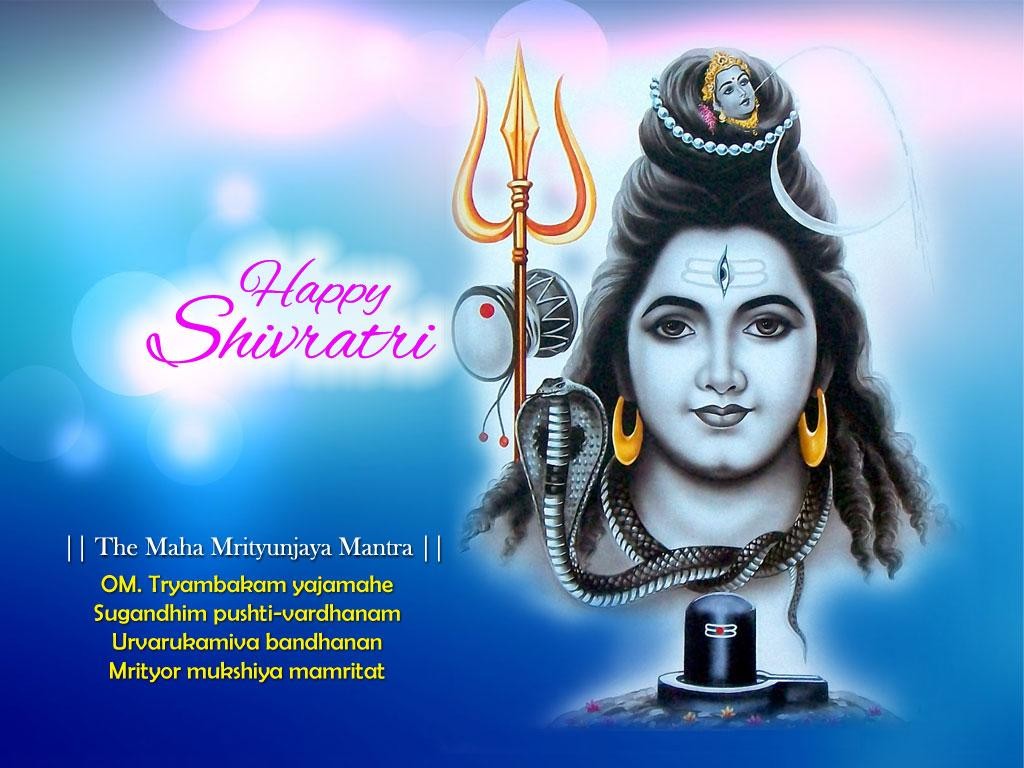
MahaShiv Ratri

Significance of Shivratri

Festival of Mahashivaratri is the most important festival for the millions of devotees of Lord Shiva. The festival has been accorded lot of significance in Hindu mythology. It says that a devotee who performs sincere worship of Lord Shiva on the auspicious day of Shivratri is absolved of sins and attains moksha.

Significance of Shivaratri in HinduismFestival of Mahashivaratri has tremendous significance in Hinduism. According to sacred scriptures, ritual worship of Lord Shiva on Shivratri festival that falls on the 14th day of the dark fortnight in the month of Phalgun pleases Lord Shiva the most. This fact is said to have been declared by Lord Shiva himself, when his consort Parvati asked him as to which ritual performed by his devotees pleases him the most.

Even till date, devotees of Lord Shiva perform the ritual worship of Shivratri with care and devotion. They observe day and nigh fast and give sacred bath to Shiva Linga with honey, milk, water etc. Hindus consider it extremely auspicious to worship Lord Shiva on a Shivaratri as it is believed that worship of Lord Shiva with devotion and sincerity absolves a devotee of past sins. The devotee reaches the abode of Lord Shanker and lives there happily. He is also liberated from the cycle of birth and death and attains moksha or salvation.

Significance of Shivaratri for WomenMahashivratri Festival is also considered to be an extremely significant festival by women. Married and unmarried women observe fast and perform Shiva Puja with sincerity to appease Goddess Parvati who is also regarded as ‘Gaura’ – one who bestows marital bliss and long and prosperous married life. Unmarried women also pray for a husband like Lord Shiva who is regarded as the ideal husband.

Thought for the day – Compassionate Soul

Acompassionate soul will travel great distances and scale high walls in order to understand another point of view.

Vijay a Ekadashi

Vijaya Ekadashi is a Hindu ritual observed during the waning phase of the moon (Krishna Paksha) in the Phalgun month of the traditional North Indian calendar. This date usually occurs in the month of February or March according to the Gregorian calendar. Vijaya Ekadashi is known as Pankoddhar Ekadasi in Orissa. The major belief behind practicing this ritual is the observance of a vrat by Lord Ram before he headed towards crossing the ocean to reach Lanka and defeating Ravana. This victory is celebrated by the entire Hindu community by observing the same vrat that once Lord Ram had kept. Know more the Vijaya Ekadashi vrat story and also learn how to observe the fast.

How To Observe Vijaya Ekadashi Vrat
Legend has it that Lord Ram, Lakshman and others began searching for a means to cross the ocean and reach Lanka. Nonetheless, it was impossible to cross the ocean as only Hanuman was capable of flying over the ocean. Thus, Lakshman mentioned about a great saint, named Bakadalabhya, who lived nearby and thought of paying him a visit on the pretext that he would be able to provide a solution. Agreed, Lord Ram and others set for the ashram of the Sage. Lord Ram was welcomed instantly and asked the sage about giving a solution to cross the mighty ocean and reach Lanka. Thus, Saint Bakadalabhya asked Ram to observe Vijaya Ekadashi in order to get rid of all the obstacles and be victorious in all their efforts.

As suggested and advised, Lord Ram observed the vrat and hence, found a way to cross the ocean. Henceforth, Ram crossed the ocean along with his army and demolished the evil King Ravana who had kidnapped Sita Devi. Since then, this fast is observed with utmost zeal and enthusiasm. Vijaya Ekadashi vrat is observed just like any other Ekadashi fast. The same rules, rituals and customs are followed. The vrat includes a 24-hour fast refraining from eating foods like rice, grains and honey. Fruits, vegetables, dried fruits, nuts and milk products can be consumed, however. The fast is observed from the night before Ekadashi and is broken on the morning after Ekadashi after offering prayers and lighting a lamp.

Read more at http://festivals.iloveindia.com/rituals/vijaya-ekadashi-vrat.html#Jsig6HqIx0z0177h.99

Vijaya Ekadashi

Vijaya Ekadashi occurs during the waning phase of moon (Krishna Paksha) in February – March. In 2015, the date of Vijaya Ekadashi is February 15. The greatness of this Ekadasi is mentioned in the Skanda Purana and observing of Vijaya Ekadasi helps in removing all the guilt associated with sins committed and also helps in attaining victory. It is believed that Lord Ram observed Vijaya Ekadashi to cross the ocean to reach Lanka and defeat Ravana.

The importance of Vijaya Ekadasi was narrated to Narada by Lord Brahma. Legend has it that when Lord Ram and his army – the Vanarasena – was searching for a means to cross the ocean to reach Lanka, Lakshmana mentioned about a great a Sage who lived nearby and said that perhaps he might provide us with a solution.

It is this sage who mentioned about Vijaya Ekadashi to Lord Ram and its benefits – observing it will help in being victorious.

All the normal rules associated with Ekadashi fasting is observed during Vijaya Ekadasi. Some people don’t sleep on the day. Grains and food made of rice are strictly avoided.


source – http://www.hindu-blog.com/2009/02/vijaya-ekadashi.html

Teaching for the day – The living entity

SB 4.29.30-31 — The living entity is exactly like a dog who, overcome with hunger, goes from door to door for some food. According to his destiny, he sometimes receives punishment and is driven out and at other times receives a little food to eat. Similarly, the living entity, being influenced by so many desires, wanders in different species of life according to destiny. Sometimes he is high, and sometimes he is low. Sometimes he goes to the heavenly planets, sometimes to hell, sometimes to the middle planets, and so on..